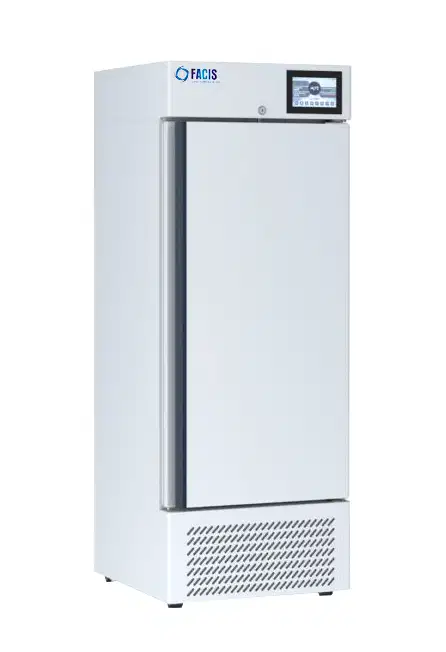
Laboratory freezer

The laboratory freezer stores sensitive samples and products, including biological specimens, plasma, reagents, and vaccines, at low temperatures. It maintains a stable and controlled temperature, from -20°C to -80°C depending on the model. By guaranteeing consistent and uniform cold temperatures, it preserves the integrity of stored products and meets the traceability and safety requirements of laboratories and the pharmaceutical industry.
Pharmaceutical
laboratory freezer

Features

Operating principle

A refrigeration unit cools the insulated enclosure. The cooling is either forced air (circulated) for a uniform temperature, or static, depending on the model. The temperature is regulated by an electronic thermostat, with continuous monitoring and alarms in case of temperature drift or door opening.

Integration

The freezer can be installed in a laboratory or pharmacy, in a vertical (cabinet) or horizontal (chest) configuration. It can be certified according to current standards and connected to a remote monitoring system.

Options & configuration

Temperature ranges from -20, -25, -30, -40 °C, up to -55 or -80 °C, vertical ventilated or horizontal static model, controlled uniformity (EMT ±3 °C), visual and audible alarms, alarm history, temperature recording, alarm reporting contact , automatic defrosting, lockable door, shelves or drawers.

Benefits

Reliable preservation of sensitive products.
Stable and consistent temperature.
Monitoring and alarms in case of drift.
Temperature traceability.
Qualification possible according to the standards (COFRAC).
Selection of format and cooling range according to need.

Laboratory Freezer Specialists

cooling

SOREMA

Food-grade water coolers and dispensers, process refrigeration and laboratory enclosures since 1956.
AgribusinessPharmaceuticals
Industrial process
SOREMA

Expert images

 sorema freezer
SOREMA laboratory freezer

FAQ.

Depending on the model, from -20 °C to -40 °C in the standard range, and up to -55 °C or -80 °C for the most demanding applications.
The maximum temperature difference expresses the uniformity of the cold within the enclosure, for example ±3 °C. The smaller it is, the more homogeneous the temperature is from one point to another.
Fan-assisted cooling circulates air for a more even temperature and faster refrigeration. Static cooling, simpler in design, is suitable for products less sensitive to temperature fluctuations.
Biological samples, plasma, reagents, vaccines and other sensitive products requiring low controlled temperature.
French expertise
at the service of your projects

Looking for an industrial solution, a specific machine, packaging or technical support for your production line?

ContactGEPPIA ​

GEPPIA is committed to protecting and respecting your data.

Search among all our content

GEPPIA logo