
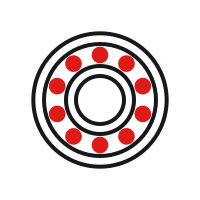
Features
Operating principle
The bearing is positioned between two parts that rotate relative to each other. Balls or rollers roll between an inner and outer ring, reducing friction and wear. The housing contains the bearing and secures it to the frame. Retaining, support, or spacer rings lock or position the components on the shaft.
Integration
These components are mounted on the shafts, bearings and guides of a machine. They support the motor and power transmission, and can be combined with linear guides and ball screws for translational movements.
Options & configuration
Ball or roller bearings, ready-to-mount bearings, retaining rings, ball joints, slides, linear guides and ball screws, transmission accessories, a wide range of sizes and references to suit loads, speeds and environments.
Benefits
Precise and low-friction rotation.
Resumption of radial and axial loads.
Machine lifespan and reliability.
Positioning and securing the trees.
Wide range of sizes and references.
Assembly and replacement are made easier by the ready-to-use bearings.
Specialists in Rings and Bearings

SIT FRANCE
Custom mechanical transmission components and conveying solutions for machine manufacturers.
Components & SystemsSolutions & Services
Expert images
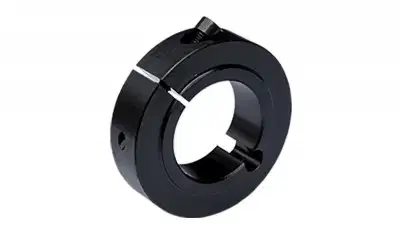
FOGEX stop ring
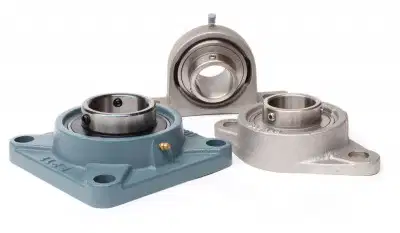
FOGEX bearing
FAQ.
What is the difference between a ring and a bearing?
The bearing allows rotation with low friction thanks to balls or rollers. The bushing, on the other hand, does not rotate: it blocks, positions, or supports a component on the shaft.
What is a landing?
This is the housing that receives the bearing and secures it to the machine frame. A "ready-to-mount" bearing assembly already integrates the bearing and simplifies installation.
Ball bearings or roller bearings: how to choose?
Ball bearings are suitable for high speeds and moderate loads. Roller bearings can handle heavier loads, but at the cost of a lower speed.
What is the purpose of a stop ring?
To axially immobilize a part on a shaft, for example to prevent a bearing or pulley from moving during operation.
Do these components also apply to linear movements?
Yes. Linear guides and ball screws provide translational movements, in addition to bearings which manage rotation.
