
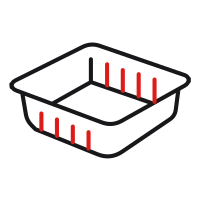
Features
Composition and materials
The tray is thermoformed from PP, PET, or PS. Single-material versions (PP, APET) are recyclable. Multilayer structures incorporate an oxygen (EVOH) or light barrier to extend the product's shelf life.
Uses and applications
It is used to package dairy products, ice cream, meat and deli meats, salads, prepared meals and fast food products. Depending on the material, it is resistant to freezing and deep freezing, hot filling, microwave reheating, sterilization and pasteurization.
Formats and variations
Customizable standard ranges or bespoke designs. Closure by sealing (sealing of a lid). Decoration by applied label or dry offset printing. Shapes and dimensions adapted to the product and the packaging line.
Benefits
Captable, for an airtight seal and good preservation.
Recyclable single-material versions in PP or APET.
Oxygen barrier (EVOH) or light available to extend the shelf life.
Resistance to processes: cold, deep freezing, microwave, hot filling, sterilization, pasteurization.
Decoration by label or dry offset.
Standard or custom sizes.
Specialists in thermoformed trays

CB EMBALLAGE
Agri-food packaging with lids: trays, tubs, lids and films adapted to each process.
Agrifoods
Packaging
FAQ.
What is a thermoformed tray?
It is a rigid plastic packaging obtained by heating and then forming a polymer sheet. It can be sealed and is used to package fresh, frozen, and prepared products.
What materials is a thermoformed tray made of?
Primarily made of PP, PET, or PS. Mono-material PP or APET versions are recyclable. Multilayer structures add an oxygen or light barrier.
Is a thermoformed tray recyclable?
Single-material versions (PP, APET) are recyclable. Multilayer barrier structures improve preservation but complicate recycling.
What is the sealing of a tray?
This involves sealing a film (lid) around the edge of the tray by welding it in place. This ensures a tight seal and, with a suitable atmosphere, extends shelf life.
Is the thermoformed tray oven-safe or freezer-safe?
Depending on the material, it can withstand freezing, deep-freezing, microwaves, hot filling, and even sterilization and pasteurization. Check the compatibility of the chosen material.
